
Recruitment in care is brutal right now. This guide unpacks what’s really going on in the care workforce in 2026, why hiring pressures are so relentless, and the practical strategies care recruitment teams can use to build stronger, more sustainable teams. Despite everything.
Health and social care recruitment feels like one of those relentless sideways-rain days. You’re sheltering where you can; clutching the umbrella; zipping up the raincoat – but you’re somehow still damp, cold, and drained.
Demand keeps climbing. The workforce can’t grow fast enough. Pay lags behind every sector you compete with. Immigration routes are tightening. Burnout is biting. Compliance is as heavy as ever.
And through it all, recruitment teams are expected to hire fast, fair, and better than ever. With less time, less budget, and fewer people, to boot.
This guide is for the recruiters in the middle of that storm.
Keep reading for:
- A quick digest on the state of the social care workforce in 2026
- A deep-dive into the major challenges hurting care recruitment this year
- A run-through of some real-world recruitment strategies to consider
Plus lots of practical examples from care providers achieving big wins.
The state of health and social care recruitment in 2026
Skills for Care’s Size and Structure 2024/25 report puts the adult social care sector at 1.71 million posts, with 1.60 million filled. That’s 52,000 more people delivering social care than last year – a 3.4% jump, and the strongest growth since before the pandemic.
But growth doesn’t mean breathing room. The sector is still carrying 111,000 vacancies with a vacancy rate of 7.0%. That’s less than 23/24’s 8.3% (Yay!) but still almost three times higher than the wider labour market (Boo!).
And in some areas the pain is even worse: domiciliary care has a 10.1% vacancy rate. One in ten roles unfilled: ouch.
Let’s explore why care is recruitment is so challenging. Then we’ll talk about some ways we’re seeing care recruiters from the likes of Avery, Bluebird Care, Horizon, Keys Group and Signature navigate successfully.
Why is care recruitment so hard?
In short, because everything the sector depends on is under pressure at the same time.
There’s no single culprit behind the care recruitment crisis (and so, unfortunately, no single fix). What makes recruitment in care so challenging is the collision of multiple forces that, together, stack onto hiring teams’ shoulders until you’re bent under the pressure.
Rising demand. Shrinking supply. Volatile immigration policy. Tough working conditions. Tight budgets. Intense competition.
Each of these hits hard on its own. Combined, they create one of the most challenging recruitment landscapes in the UK. Let’s unpack them.
Demand is rising faster than workforce growth
Care demand is rising faster than the workforce can grow, lumping huge pressure onto recruitment teams.
CQC report that requests for local authority-funded adult social care rose 4% in 2023/24, for example, and 8% compared to 2019/20, driven by ageing populations and more complex needs.
Skills for Care’s forecast is blunt. Based on demographics alone, England will need around 2.17 million care posts by 2040 – that’s 470,000 more roles than today.
And that projection doesn’t include any additional pressures from the rising complexity of need, integration with health, changes in commissioning, or shifts in workforce expectations.
It’s the floor, not the ceiling. But right now it often feels like we’re stuck in a basement many levels underground.
THE BOTTOM LINE: There’s always more to fill. Recruitment never stops; recruiters never sleep.
Domestic disinterest meets international sanctions
One of the starkest trends in recent years is the shift in who actually works in care.
Skills for Care’s data shows that posts filled by British workers dropped by around 30,000 last year and have fallen by roughly 85,000 since 2020/21 – a 7% decrease. At the same time, roles filled by non-EU nationals increased by 80,000 in a single year, and by 255,000 since 2021/22.
With declining domestic interest in care roles, international recruitment has been the engine of workforce growth. But it’s proven to be a fragile foundation, thanks to immigration policy volatility.
For instance, Skills for Care say the number of new arrivals starting direct care roles fell from around 105,000 in 2023/24 to only 50,000 in 2024/25, following immigration rule changes. And CQC data shows an 81% drop in Health and Care Worker visa applications between April to July 2024 and the same period in 2023.
THE BOTTOM LINE: Fewer home-grown candidates. And now fewer international ones too.
Tough working conditions drive burnout and turnover
The independent sector’s turnover rate dropped to 24.7% in 2024/25, Skills for Care shows, compared to 33.2% in 2019/20. That’s movement in the right direction, for sure.
But that still means one in four people leaves their care job every year.
Care recruiters are grappling with the on-the-ground reality of around 400,000 job leavers annually, turning recruitment into a continuous, reactive cycle.
Burnout is a big driver. Care work is deeply meaningful but it’s also deeply demanding. And getting more so, as people live longer and have more complex, more demanding needs.
The on-the-ground situation isn’t great. Skills for Care’s 2024/25 data shows average sickness absence is 4.5 days per worker, totalling ~6.6 million days lost across the workforce.
It’s a vicious cycle that many providers feel trapped in, with burnout driving absence which amps-up pressure which drives burnout.
THE BOTTOM LINE: A back-fill nightmare. Recruiters are sprinting just to stand still.
Care pay still lags every sector you compete with
The care sector is battling a pay crisis that makes attracting and retaining people an uphill struggle.
Skills for Care’s latest pay update shows median hourly pay for care workers in the independent sector was £12.00 in December 2024, just 56p above the National Living Wage at the time. (This was prior to the NLW increase in April 2025, which directly impacted 93% of adult social care providers).
Nearly a quarter of care workers are paid the bare minimum, with very small pay differentials for experience. As CEO, Professor Oonagh Smyth, writes:
“Low levels of hourly pay, combined with a lack of pay progression for experienced care workers, make it harder to attract and keep good people. Pay isn’t a magic bullet that will fix all the challenges our sector faces. But it’s a significant influence on the wider quality of social care roles – and we know from our data and insight that it’s one of the things that affects staff turnover.”
Care recruiters aren’t just competing with other care providers. You’re competing with NHS support roles, supermarkets, warehouses, local government, and hospitality jobs that often pay more for less responsibility and emotional load.
For example, The Unfair to Care report on the social care pay gap illustrates that many frontline social care workers would be paid 39% more – nearly £7000 per year – in equivalent positions within the NHS, local authorities and other publicly funded industries.
£7000 a year is a lot to try and persuade someone to give up for the sake of a meaningful career helping people. Especially when the comparable options often also offer a meaningful career helping people.
THE BOTTOM LINE: Candidates choose retail and hospitality, warehouses, logistics, local government, or the NHS instead of a career in social care.
Fragile provider finances strangle recruitment capacity
Double-digit inflation, rising wage costs, and chronically squeezed budgets have put enormous pressure on organisations that were already working with razor-thin margins.
The Institute for Government’s Adult Social Care Performance Tracker highlights how the care sector has been neglected by successive governments, with care spending unable to keep pace with the rising cost of delivery.
Then mandatory wage increases and employer NI changes hit providers hard, further squeezing any discretionary spend
It’s unsustainable. So much so that Care England reported in 2023 that one third of adult social care providers are considering exiting the market amid financial pressures. The situation hasn’t improved much since then.
And the result is all too predictable:
- Too-small TA teams
- Untrained managers pulled into recruiting
- No time or budget for strategic stuff
- Outdated recruitment systems
- Slow recruitment processes
- Inconsistent comms and poor CX
- Growing dependence on costly agency staff
And there we are, at yet another vicious cycle, with poor recruitment capacity leading to more vacancies, which leads to more agency use, which deepens the financial pressure.
THE BOTTOM LINE: Recruiters are doing mission-critical work without the tools, time or investment they need. And they can’t keep doing it forever.
Compliance-heavy processes increase drop-outs
Compliance is one of the heaviest invisible weights dragging down recruitment in the care sector. Adult social care is one of the most tightly regulated sectors in the UK, and rightly so when people’s safety depends on it. But the sheer volume of checks often creates a bottleneck that slows hiring to a crawl.
Every new hire requires a stack of digitally-auditable evidence, like:
- Enhanced DBS checks
- Right to Work verification
- Employment history checks
- Character and employer references
- Mandatory training records
- Vaccination evidence in some settings
These requirements are essential safeguarding. But they make care recruitment inherently slower and more admin-heavy than almost any other sector.
The problem is that most providers are still managing compliance checks manually. Recruitment teams are chasing documents over email; hiring managers are storing files in personal inboxes; spreadsheets track who’s done what; PDFs get lost; onboarding stalls for days or weeks.
And candidates don’t wait. When a warehouse or retail role can start tomorrow, a many-week pause for care compliance is a dealbreaker. Leaving recruiters pulling your hair out with lost candidates, delayed starts, frustrated teams, and more pressure on already-stretched services.
Successful care recruitment demands fast, fair, watertight hiring. But few teams can get there.
THE BOTTOM LINE: Compliance processes that move like treacle drive candidates away.
Candidate expectations are rising
A fast, fair, modern candidate experience is essential to effective hiring. Applicants expect:
- Flexible, fast forms
- Quick decisions
- Mobile-first journeys
- Real-time updates
- No friction
- No long load times
- Fair, accessible processes
- Personalised relevant questions
But with limited time, resources, or breathing room, care organisations often fall short here. Many providers still use sprawling forms, black-box processes, repetitive questions, generic forms, and desktop-first journeys that simply don’t work on mobile screens.
The problem is, you’re competing with the best that’s out there; not just the best in care. If a warehouse job can hire someone tomorrow with a five-minute mobile form, a care provider using slow, manual, desktop-first processes is at an immediate disadvantage.
Candidates won’t wait. They go where the experience is fast, clear, and convenient.
THE BOTTOM LINE: Candidates want modern and fast, but many care hiring journeys are stuck in the slow lane behind the tractor.
Care recruitment strategies for 2026
Care recruitment asks ever-more from recruiters while leeching away support; pitting you against better-paid, less demanding jobs and expecting you to walk through a compliance minefield to hire yesterday.
It’s a structural problem that recruitment teams carry the weight of every day. And there’s no single solution, of course.
But even in a sector this tough, the best care recruitment teams are finding ways through. Not by working harder (HA!) but by working smarter, with better processes, data-driven decision-making and technology that lightens the admin crush.
Here are the recruitment best practices we see forward-thinking care providers adopting for the year ahead.
Designing short, snappy, mobile application processes
Most care candidates don’t apply for care jobs from laptops. They apply from buses, bedrooms, car parks, and coffee queues.
Appcast’s 2024 Recruitment Benchmarks report found that mobile can account for more than 80% of applications in on-the-go sectors, for example. And care is nothing if not on-the-go.
Yes, you need to collect a ream of essential info so you can make safe, fair, accurate decisions. But if that comes at the cost of candidate experience, you’re losing talent you never even saw.
Smart care teams are:
- Cutting long forms
- Breaking the process into short, staged steps
- Reducing mandatory fields upfront
- Using WhatsApp/SMS comms
- Offering “apply without a CV” options
- Embedding video questions instead of long competency forms
- Giving candidates a self-serve portal for real-time updates
- Using an accessible, modern platform
Adopting values-based recruitment
Values-based recruitment makes a heap of sense for the care sector. One study from Lancaster University showed that most people who choose a career in the sector do so for values-based reasons:
- 73% said, ‘Knowing the job makes a difference.’
- 72% said, ‘Gaining satisfaction from caring for others.’
- 63% said, ‘Being proud to work in the sector.’
Adopting a values-based model of recruitment means recruiting and retaining people who align with the values and culture of your workplace. Rather than purely emphasising past skills and experience.
As Skills for Care put it, “values-based recruitment results in lower recruitment costs, positive return on investment, lower staff turnover and better staff performance.”
A values-based recruitment approach impacts every element of your end-to-end hiring function:
- Articulating your values and culture (AKA: developing your EVP)
- Attracting and sourcing candidates who align to your values
- Designing application processes that allow candidates’ values to shine
- Assessing whether candidates share your values
- Onboarding employees so they can embody your values day-to-day

Source outside traditional job boards
If you do what you’ve always done, you’ll get what you’ve always gotten, as the saying goes. If you’re over-reliant on the traditional job boards, you’ll continue to struggle with the same tight talent pools everyone’s struggling with.
In 2026, we expect to see care recruiters diversifying their attraction and sourcing strategies, including stuff like:
- Out of home advertising
- Referral programmes
- Open days
- Outreach to leavers
- Social recruiting campaigns
- Local community outreach
- Engagement with schools and colleges
- Intern programmes
- Professional networking channels
- Charity events
- Level-up your job descriptions
Outside-the-box care sourcing is something charity Mencap are excellent at, attracting candidates via:
- Back-of-bus advertising and banners in high-traffic areas
- Managers and staff putting up posters in their communities
- Non-recruitment open days to showcase their range of careers
- Refer a Friend scheme with boosted bonuses for holiday surges
- Personalised postcards sent to leavers (who then often become returners)
Double-down on talent pooling
If sourcing starts when a role becomes empty, you’re stuck on a never-ending treadmill. High-performing care recruitment teams build warm, local talent pools – and keep them engaged and active, so they’re hot to trot when you need them.
Look at your:
- Former employees
- Silver medallists
- Bank workers
- Students
- Seasonal care assistants
- Returners / retirees
- Volunteers exploring a career in care
Then keep these pools warm with occasional check-ins, upcoming opportunities, training invites, or ‘care roles this month’ bulletins. So when you’re hiring, you’re rarely starting cold. (Here’s a step-by-step guide to talent pooling, if you need one).
See how Tribepad supports proactive talent pool recruitment, with:
- Built-in CRM with tagging
- No-code landing page builder
- SMS and email campaigns
- Comprehensive search tools
- Intelligent job alerts
- Heaps of automation
- Robust tracking and reporting
Get loud with employer brand
Care has an image problem: low pay, stressful work, ‘unskilled’ labels. But the story inside great care organisations is the opposite: purpose, expertise, and deep human impact.
The best TA teams are shifting public perception by:
- Telling real care stories
- Putting their people front and centre
- Showing progression pathways
- Using short-form video and social recruiting
- Running community roadshows and open days
Having a strong employer brand reduces cost-per-hire, increases quality and boosts retention. For example, LinkedIn’s research shows that a strong employer brand delivers:
- 28% reduced turnover
- 50% lower cost-per-hire
- 50% more qualified applicants
- 1 – 2x faster time-to-hire
In other words, it’s a no-brainer. Have you articulated an EVP that resonates with your people? Do all your channels showcase that? Do your recruitment marketing campaigns build on and develop that message?
And bear in mind – authenticity can’t be faked. Candidates aren’t just checking out your careers site anymore. They’re more likely asking ChatGPT what working for you is really like. If what you say doesn’t reflect what people say about you, there’s a bigger piece of introspective cultural work needed.
Accommodate more flexibility at work
The old model of ‘we need 10 FTEs’ is cracking under pressure. Rigid scheduling excludes a whole heap of people who might make excellent care staff, like parents, students, carers, retirees, people with disabilities, and people working multiple jobs.
Those are people the sector’s going to need to attract, if we’re to meet that 470,000 additional staff by 2040 forecast.
And flexibility is a major draw. So much so that 29% of care workers would actively change jobs for more flexible working hours. In the midst of a recruitment and retention crisis, that feels like an important lever.
Flexibility is a key pillar in the NHS’ 10-Year Plan, and the same applies for the wider health and social care sector: flexibility is central to build a sustainable, future-proof workforce.
Tackle the gender gap
At the 2025 Care Show, Liz Jones of National Care Forum shared Skills for Care data that only 21% of the adult social care workforce is male, compared to roughly half of the population.
That’s a big untapped talent pool. And a big opportunity to provide better, fairer services that better serve end users too.
Take David – an older man who’s uncomfortable being washed or dressed by female carers. He’s not ‘refusing care’ – he’s embarrassed. Visits become tense. He delays showers, skips shaving, becomes withdrawn, and small health issues go unnoticed because he won’t talk openly.
But when a male carer is scheduled, everything shifts. He relaxes, engages, accepts support, and maintains his routines. His wellbeing improves simply because his care matches his preferences.
In 2026, could your team do more to attract, engage, and inspire more male care workers? Simple changes could reap big gains – like adding male team members to your careers site, for example.
Explore AI – ethically
We all know AI is reshaping talent acquisition, bringing radical new threats (10x applicants, anyone?) as well as radical new opportunities. The dynamics of care – high-volume, high urgency, and heavy compliance – make AI astronomically valuable – but also challenging and high-stakes.
AI can massively help care recruitment. But recruiters must:
Ensure fair, bias-free decision support
Comply with regulations on automated processing
Avoid over-automation that alienates applicants
Make sure tools are accessible for low digital literacy applicants
Maintain human warmth in a deeply human sector
Protect managers to ensure they use AI responsibly
The strategy shouldn’t be “adopt AI”. The strategy needs to be “adopt AI safely, fairly, and in a way that reflects the values of care.”
Tribepad Sidekick is our fully-integrated AI recruitment assistant, built with transparency, responsibility, and ethics at its core. So you don’t just get faster. You get it right faster.
Invest in the right recruitment tech – your whole strategy sits on it
Yes, budgets are tight. But none of this works if your recruitment platform can’t support it.
The right recruitment software won’t fix the care sector’s structural, systemic challenges. But it will give recruiters the breathing room, speed, visibility and control to compete when the odds feel stacked against you.
Ultimately, your talent acquisition software is the foundation that your hiring strategy, processes and people sit on. The right tech won’t solve all your problems. But those problems will feel a whole lot worse with your hands tied behind your back.
Compliance 62% faster for HCRG Care Group
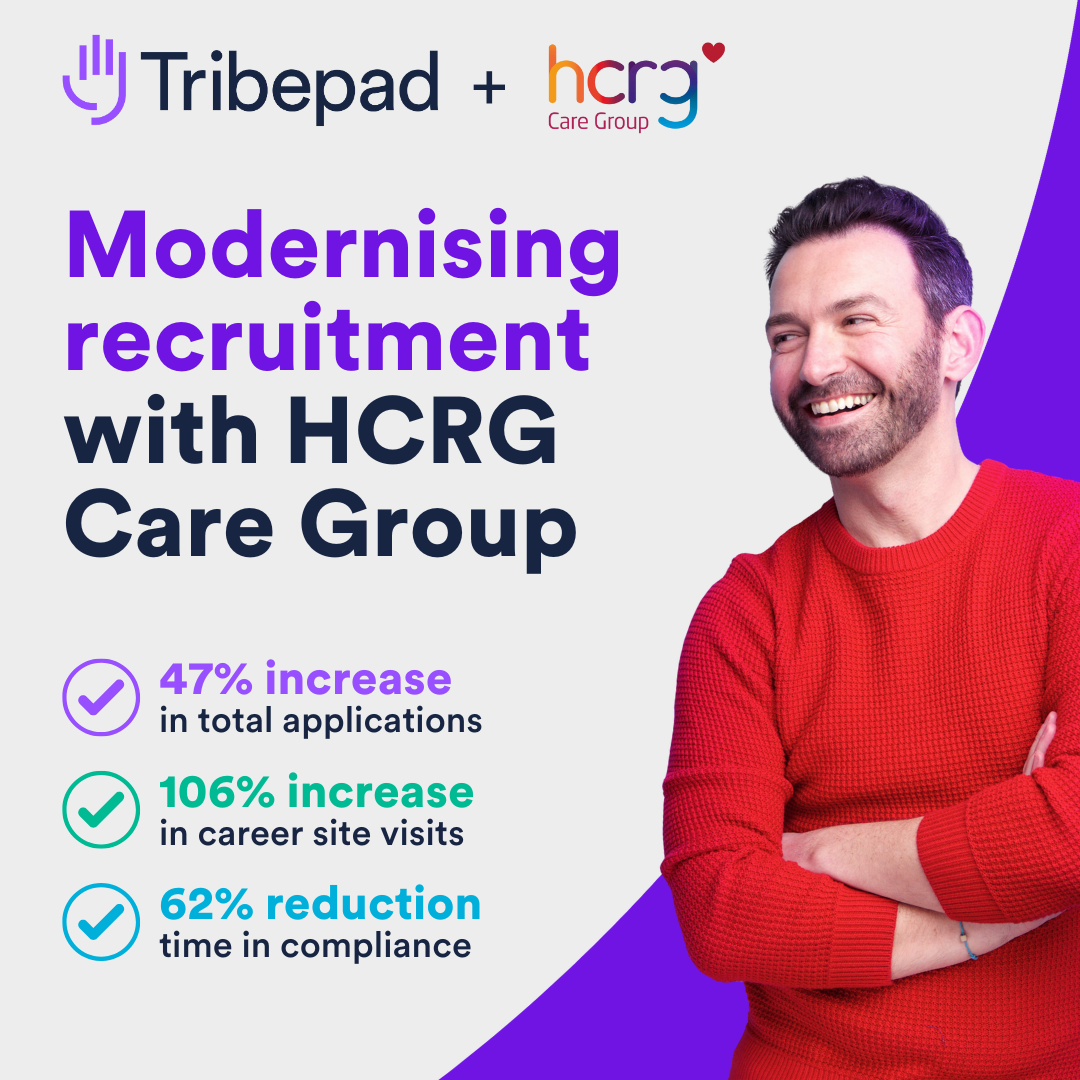
Read how HCRG Care Group landed 106% more career site visits, increased applications by 47%, and reduced time stuck in compliance by 62%, with Tribepad. Resulting in FTE headcount growth of 5% despite higher-than-usual churn. And a total revamp of recruitment’s credibility.
Tribepad is the trusted tech ally to smart(er) recruiters everywhere. Combining ATS, CRM, assessment, video screening, compliance, onboarding, analytics and a fully-integrated AI assistant, our talent acquisition software is a springboard for fairer, faster, better recruitment for everyone.
B-Corp certified and multiple-award-winning (like Best ATS for Enterprises and Tech Company of the Year), Tribepad is trusted by care organisations like Bluebird, Avery, Horizon, Keys Group, HCRG Care Group and Signature.


